Showing posts with label Mark Ruffalo. Show all posts

Tuesday, December 16, 2014

Foxcatcher (2014) – Review

Review: Foxcatcher is a dark and intense character study.

The film is about Mark and David Schultz, brothers who both won Gold Olympic Medals for wrestling in 1984. In 1987, Mark is approached by wealthy businessman John du Pont, interested in making his family farm, Foxcatcher, into a wrestling training facility. Mark agrees to join du Pont on his farm, while his brother Dave is hesitant initially, but eventually gives in to du Pont’s financial advances. Mark wants to be the best wrestler in the world, but there is a weird dynamic that starts to develop between him and du Pont that distracts him. Meanwhile, du Pont struggles with feelings of paranoia and jealously, specifically targeted at Mark’s relationship with his brother. As tension mounts, feelings of uneasiness and fear form between each of the men.

Films made as pure character studies are almost unheard of in today’s cinema, as audiences seem to need narrative to direct and engage them. With Foxcatcher, director Bennett Miller seems to have made a pure character study – maybe in the guise of a sports drama. The results of the wrestling matches are meaningless to this film (which seem to be the character’s main focus). Instead, this film is solely focused on the darkness that seems to be brewing in these characters (more specifically John du Pont and Mark Schultz).

John du Pont, as presented, is incredibly powerful, seemingly getting everything he wants. Miller often shows him in meetings with military personnel and surrounded by military hardware (du Pont’s family company is a leader in arms manufacturing). Yet, he grew up friendless and his mother seems to have had a negative impact on his upbringing, creating a man who is very envious of what others have. Maybe deep down, he just wants to be liked, but only on his terms. Growing up in controlled isolation, feeling both powerful and alone, he wants to be respected and have friends, but is jealous of others who garner similar feelings in others.

Meanwhile, Mark Schultz, though an Olympic Gold Medalist, lives in his brother’s shadow. His brother, Dave, is a student of wrestling – competing not only as a world class wrestler but also as an expert coach. Mark has what it takes to be the best, but seemingly only if his brother teaches him and prepares him. In du Pont’s offer to train at Foxcatcher, Mark sees an opportunity to make a name for himself on his own – something he craves; however, without his brother’s positive influence, Mark falls on bad habits and is overconfident. He does not seem to be able to make it on his own, which only feeds into his own negative tendencies.

John du Pont and Mark Schultz form almost a father-son relationship as Mark trains for the World Championships in 1987. At first, everything seems to be going well and they become friends. Yet, Mark finds himself distracted by John’s needs – he wants to be regarded as a good wrestler as well, he introduces Mark to drugs and he is not a real coach even though he likes to think of himself as one and be treated as one. John seems to want all the benefit with none of the work – both in terms of being Mark’s father figure and turning Mark into the best wrestler in the world. The problem is, however, that Mark needs a real mentor and coach, like his brother, to get him ready. Left to his own devises, he is self-destructive. Thus, extreme frustration builds in both men – neither getting exactly what they want out of their relationship in the long-term. John also seems to be emotionally manipulating Mark, making him feel bad much in the same way John’s mother emotionally bullies him.

When Dave joins them at Foxcatcher, it proves to be a recipe for disaster. By this time, Mark is already emotionally finished with John, after failing at the 1988 Olympics and being treated poorly by John. Meanwhile, John, plagued by unfounded feelings of jealously and paranoia, sees Dave as replacing him as the head of Foxcatcher wrestling – as coach – and poisoning his good relationship with Mark.

Miller does not really make big narrative choices with the film in terms of telling a story. The wrestling matches are not really that important (though, they are designed and executed very well and are quite compelling). Instead, he wants the audience to focus solely on the characters – on the anger and madness that seems to grip them. I almost think that the most interesting character is Dave. He seems the most normal and is clearly aware that things are not right with John du Pont and yet he stays and placates him. Is he corrupted by the money that John is offering both him and USA Wrestling? Is he making a personal sacrifice for the greater good of his sport? He also sees the pain and anger in his own brother, who definitely has a hard time in life (for whatever reason). He is very supportive of his brother and does everything for him. Ultimately, he finds himself between these two broken people, and his goodness is eventually enveloped by the darkness that he attempts to take on.

The film is tonally incredibly bleak and intense, and paced quite slow. Miller could have easily staged the narrative as a thriller (as du Pont descends into madness) or given the film more narrative touchstones (or clichés) that the audience recognize in its structure. I call the film a pure character study because Miller simply presents his characters, all narrative elements exist only as background devices to place them in time and space, allowing them to naturally gestate for the audience as complex emotional beings. As a result, the film is very gripping in moments and fairly slow in others. The film is not so much entertainment as it is a deep look into human emotion (focusing more on its darker spectrum: pain, anger, fear, paranoia and so on).

Foxcatcher is brilliant in terms of it character work, exposing its characters’ souls; but it is not an entertaining film and certainly will not work for anyone expecting something light or story-driven. Yet, for those wanting to look deep inside these characters, to explore both the darkness and light of man, it is absorbing.


Technical, aesthetic & acting achievements: Bennett Miller is an excellent director, especially when it comes to digging deeper into his characters. His three features, Capote, Moneyball and now Foxcatcher, all have interesting stories that surround the characters, but Miller focuses on his characters, presenting the narrative elements as purely background – elements that merely place his characters in a moment in time but do not define them. Miller is much more interested in their emotional makeup and what elements in their past have contributed to their emotional makeup in the present. He also elicits wonderful performances from his actors – something that would seem essential for a director that is so focused on character. While I think (objectively) Capote is his best film to date, my personal favorite is Moneyball. I very much look forward to what he does next.

Composer Rob Simonsen’s score is understated, almost nonexistent in many instances; yet, it helps establish the tone of the film very well, as it plays on the darker themes. Cinematographer Greig Fraser’s photography as well seems to cast a very dark, bleak hue over the film, as his palate is almost void of color. Really, the film is rather depressing from a visual stand point (although, Fraser’s work is also very good – there is a beauty to his shots of the farm). Jess Gonchor’s production design grounds the film in a very naturalistic, realistic space. The film feels authentic, both in performance and visual aesthetic.

The performances in Foxcatcher are all excellent. Vanessa Redgrave does not have much screen time as John du Pont’s mother Jean, but her presence lingers over him. She is firm and overbearing in her scenes with him, casting down disapproval, which seems to haunt him. Mark Ruffalo is brilliant in the film. His performance as David Schultz feels extraordinarily natural, as if he were born and lived his life as the character. It is quite remarkable. Steve Carell is incredible as well. His performance is so different than anything he has done before. His portrayal of John du Pont is chilling, as he creates an emotional bully (taking out the emotional burden that his mother puts on him on others). The performance, however, does not feel as natural, as Carell is clearly in a lot of make-up that makes du Pont feel somewhat cartoonish at times. Channing Tatum is also great as Mark Schultz. He is able to emote so much pain and anger, as he seems to not be able to cope with his inner demons.


Summary & score: Foxcatcher features many of 2014’s best performances, as the film explores the dark emotional recesses of its dynamic characters. It is a skillfully crafted pure character drama, in the truest sense. 8/10

Tuesday, July 8, 2014

Begin Again (2014) – Review

Review: Begin Again is a sweet music drama about picking yourself up off the ground when life gets you down (while also taking a few shots at the commercial music industry).

The film is about Greta and Dan. Greta is a songwriter who comes to America with her boyfriend Dave, a singer on the verge of becoming a rock star. As he blows up, they break up after Dave cheats on her while he is on the road leaving her alone in New York City, with only a friend’s couch to sleep on. Greta is devastated because she had always felt like they were a team (even working on music together) and he abandoned her. Meanwhile, Dan is a record producer and co-owner of an indie label; however, things are not going well for him either. He has been on a long slide and is an alcoholic. Things have become so bad that his ex-wife and daughter feel slightly estranged and his music partners have thrown him out of the business. He has nothing left. Greta and Dan come together when Dan sees and hears Greta (in a state of anguish) perform one of her songs. It seems to pull him out of his stupor and invigorates him to make and album with her. Maybe they can help each other move on and begin again (see what I did there…).

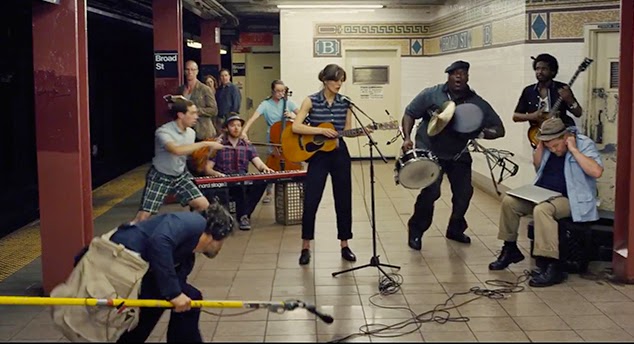
Writer-director John Carney presents Begin Again as a modern musical – one in which the music aspects of the drama come in the form of performed songs by musicians, songs that also double as emotional outlets for the characters. In this regard, Carney has done quite well. The songs and music work very well within the construct of the narrative. The music is by no means groundbreaking or amazing, but it seems to fit nicely into today’s rock/pop genre, and most importantly it gets its message across (speaking for what the characters are feeling). I also did enjoy the typical musical cliché montages (they are almost always great) like “finding the band” or “making the album”.

Carney also uses his narrative to raise very directed criticisms with the commercial music industry. Carney certainly finds himself on the side of musicians and artistic integrity. The film to some extent berates the industry for over commercializing and focusing on other aspects than the music (which theoretically should be the most important aspect). Carney is a proponent of what seems like music’s future: one in which there are no all-powerful record labels and bands promote themselves and solely release music online (basically turning every band into an indie band), theoretically doing away with the commercialization of music and musicians (major labels to some extent dictate what gets played on the radio, which then in turn seems to force popular music to all sort of sound the same so that it may appeal to the masses, and thereby artistry, creativity, and the soul of music is lost – this is what Carney is fighting against). This viewpoint is nice in theory, but also feels a little naïve.

The strongest feature of Begin Again is its characters Greta and Dan (but especially Greta). Carney goes out of his way in the narrative to fully flesh out the characters and make them relatable for the audience, by giving them many character moments and full back stories. This works very well and pays off, especially when the characters then perform their music. I also liked that Carney does not feel the need to make the film into a clichéd romantic comedy with Greta and Dan falling in love. That is too easy, and it would not have allowed the characters to really grow and move on with their lives past the low points that the audience first finds them in. Their narrative arcs would feel cheapened.

Begin Again, however, does not quite have the emotional weight that it could have or probably should have. Carney seems intent on keeping things rather light, when the emotions and issues that Greta and Dan face are fairly heavy. This, thusly, creates sort of an emotional disconnect and leaves the film feeling less satisfying on an emotional level. Carney also has a big issue with the ending feeling very unsubstantial (something that he tries to rescue with a decent scene during the credits). There is not a sense of real closure to the film, which is disappointing because the audience does care about Greta and Dan and wants to see their story(ies) tied up in a meaningful way, and Carney just seems to miss this narrative moment. Possibly, this unsatisfying feeling stems from Carney not having Greta and Dan end up together when we, as the audience, are somewhat hardwired by film’s narrative language (especially based on hundreds of recent similar narrative films) to expect and maybe even want that ending. Mostly, however, it feels like Carney just could not come up with a strong enough ending while keeping the tone light throughout.

Overall, Begin Again works and succeeds on what its sets out to be. It is an entertaining lighthearted musical drama with strong character performances and good (enough) music. What is disappointing, however, is that it could have been very powerful. It just never really seems to have that ambition.


Technical, aesthetic & acting achievements: Many film fans know John Carney for his amazing and emotionally powerful film Once, and thus probably hoped that Begin Again would follow suit; however, Carney has seemingly sought out to make a film with a broader appeal and has thus made something far more lighthearted tonally (which is somewhat ironic, considering the film’s clear appeal for artistic integrity over commercialization). That said, however, I do not see this cynically as Carney chiefly trying to make a generic Hollywood film, as Begin Again clearly is not that; it stylistically and narratively firmly has its roots in independent film. I just think he tried to make something different and it just did not come off quite as well. Fans of his work should still enjoy the film though.

As mentioned in the review, the film’s music is well suited. The score and songs mostly written by Gregg Alexander (of the New Radicals) have some very good moments and are performed beautifully by the cast. Yaron Orbach’s cinematography is also very good. The film has a very naturalistic look and takes full advantage of New York City’s inherent charms. Chad Keith’s production design too is naturalistic, creating a world that feel very authentic for the characters to inhabit (doing part of the actors’ job for them).

Begin Again features a few musician cameos like CeeLo Green and Yasiim Bey and good work from actors in small roles, chiefly from Catherine Keener. Hailee Steinfeld is good as Dan’s daughter Violet. Her character seems to serve Dan’s character arc more than her own, but Steinfeld nonetheless brings her to life with fun, slightly edgy energy. James Corden is fantastic as Greta’s friend Steve. He is very funny and seems to steal all his scenes by pulling all the attention. Adam Levine is also good as Greta’s rock star boyfriend Dave. I am not very familiar with his work with Maroon 5, but he sure can sing. Mark Ruffalo brings a lot of depth to Dan. His performance to some extent feels like a clichéd caricature of the typical sort of wacky “indie music guy” but Ruffalo also has a real sadness, making the first level feel like it is just an act to try and hide his immense pain. He brings layers to what would in most cases been a fairly straightforward performance and character. Keira Knightley is easily the best part of Begin Again. She can sing (despite not being a singer in any regard), helped along by songs that suit her voice. She is incredibly charming and likable as Greta, pulling the audience in, and nails all the dramatic moments as well. I will say, however, that she is maybe not completely right for the character. She is far too inherently cool. Throughout the film, she is stylishly dressed and seemingly effortlessly alluring and fashionable (reminding me of Audrey Hepburn in Funny Face a bit), when Greta feels like a woman that would not be very fashion forward, not necessarily ugly or unkempt, but just not as put together in terms of style and overall look. But regardless of all that, Knightley is wonderful in the film.


Summary & score: Begin Again has a good set of songs (a key ingredient to any musical), strong leading performances, and a good message, but is a little let down by its upbeat nature when deeper emotion would have made it all the more dynamic. 6/10

Tuesday, May 8, 2012

The Avengers (2012) – Review


Review: The Avengers is a brilliant action adventure film, chock-full of huge action set pieces, witty dialog, funny moments, and great characters. The film is about Earth’s mightiest heroes (Iron Man, Captain America, Thor, Hulk, Black Widow, and Hawkeye) teaming up together to stop an alien invasion brought about by Loki. The Marvel Studios films have prized entertainment over everything, as they built up to The Avengers. Often, however, they left the audience wanting, as character and drama resonate more than just a fun experience. Writer-director Joss Whedon had a daunting task ahead of himself taking on a film with essentially six main characters, each requiring their own character moments. Whedon does a fantastic job balancing the mandate from Marvel for The Avengers to be highly entertaining and enormous in scale and getting the necessary drama and character moments for the many characters while keeping the film ever moving forward. The great achievement of this film is not so much the great action set pieces but rather Whedon’s ability to give every character enough to build a connection with the viewer. The audience understands the ethos of each character, and Whedon does this very economically (once it gets going, it never feels slow). There are stakes for the characters in this film, which makes their struggle all the more meaningful for the audience (though, at the same time, the fact that Marvel already has sequels set up for these characters somewhat diminishes the stakes as we all know they are going to make it through just fine and off onto their own films – we know there are no real mortal consequences for the main characters going in). Along with giving each character their moments to shine (dramatically and otherwise), Whedon also understands the dynamics between the characters, and the best scenes in the film come when these characters are onscreen together (both as a team and as bickering self-important egos). The film hits its stride (starting a bit slow) when these characters are put together (beginning with Captain America going after Loki and Iron Man showing up). He also gets each character individually, and worked with each actor to create wonderful dramatic characters and performances. Once the Avengers are all together, the film is just a lot of fun – both in terms of very well done action set pieces and hilarious dialog and other jokes (Hulk and Iron Man probably get the best material). Whedon’s sense of humor lends itself perfectly to this film. There are as many sheer moments of laughter as there are ‘wow’ moments. Structurally, Whedon sets the film up to play almost as a third act to the five prequels (Iron Man, The Incredible Hulk, Iron Man 2, Thor, and Captain America: The First Avenger). The characters are briefly reintroduced (though, most of the early characters moments were taken out of Whedon’s first cut as it came in at 3 hours), but Whedon assumes that the audience already knows who these characters are and proceeds accordingly, jumping right in. Plus, the film is so much fun and so entertaining, the narrative is really secondary, and even unimportant (because, really, all the audience wants is to see these characters interact and team up – and both these things happen – what they battle against is not important, only that we get to see them do it). Also, the narrative constantly builds towards the final battle, as the stakes seem very immediate. Whedon does a great job with the pacing for the most part. Again, the beginning gets off to a slow start (and maybe this is just because we cannot wait to see the Avengers all together), as characters are reintroduced and rounded up (playing a bit like a Muppet movie or a getting the band back together narrative); but once they are together, the pacing is brisk and efficient (at 142 minutes, the film seems to fly by). While The Avengers is not quite on the same level as Christopher Nolan’s Batman Begins and The Dark Knight or Sam Raimi’s Spider-Man 2 (the tier one of superhero films), it is just a level below (with X-Men: First Class), and easily the best of the Marvel Studios films. Entertainment over everything is again the mantra for The Avengers, but Whedon has also included enough character moments and resonance to create what will likely not only be the most entertaining film of the summer, but also one of the best.


Technical, aesthetic & acting achievements: Auteur Joss Whedon has long been a cult hero (since the days of his Buffy the Vampire Slayer TV series), churning out beloved work but constantly struggling with reaching a larger audience (three of his four TV shows were cancelled, and his first feature Serenity grossed just $39.5 million worldwide). Now, with both the critical and box office success of The Avengers (opening to the biggest box office weekend ever to date), he can probably do whatever project he wants next (and that is a great thing for us all). His writing and directing on The Avengers is phenomenal work, capturing and managing all the characters perfectly. Composer Alan Silvestri’s (who also scored Captain America: The First Avenger) score accompanies and accentuates the scale of the film. It is already a huge film with grand action set pieces (Marvel apparently wanted this to be even bigger, scale wise, than Transformers: Dark of the Moon), but the score booms with heroic emphasis (here is an example). His work also captures the more emotional character moments as well – it is a very good film score. Seamus McGarvey’s cinematography is excellent. Again, the scale is enormous and McGarvey’s camera certainly is able to wonderfully present all the action. His work is very crisp and clean (keeping with the aesthetic set out in the first Iron Man film, and carried throughout the series). Amidst all the action, Whedon and McGarvey excel at still capturing the smaller moments too. Production designer James Chinlund does good work as well, upping the scale. Most of his sets are just big areas in which the Avengers get to play. Overall, aesthetically the film is great, but it is the performances and wonderful characters that make this a brilliant film. There are a lot of characters in The Avengers (6 Avengers, 3 S.H.I.E.L.D. agents, Loki, and assorted other characters old and new from the Marvel Studios universe). Gwyneth Paltrow and Stellan Skarsgard are good in their small roles, while Samuel L. Jackson, Cobie Smulders and especially (and maybe surprisingly) Clark Gregg are very good in support. Tom Hiddleston’s Loki is sort of an old school villain stylistically – always monologuing and strutting around. It is great fun. Jeremy Renner’s Clint Barton (Hawkeye) is probably the least exuberant of the Avengers, and that is because he plays the character so well – very reclusive and removed. Unlike most female characters in action adventure films, Scarlett Johansson’s Natasha Romanoff (Black Widow) is never the damsel in distress, and is probably the most put together of any of the characters. She exudes confidence, not because she is a demigod or has super powers or super tech but because she knows exactly what she is capable of and how to approach any enemy or situation. It is a nice change of pace. Chris Hemsworth again owns Thor. He is just rippling with ego and entitlement, but also heart. Mark Ruffalo, working with Whedon, finally gets the Hulk right. He is not just a mindless animal, but the epitome of human rage. Chris Evans as Cap and Robert Downey Jr. as Iron Man serve as sort of the leads in the film. Steve Rodgers take up the mantle of the leader of the Avengers while Tony Stark steals most of the scenes and is completely charismatic, but dramatically they need each other to grow. Downey Jr. is Stark utterly, and is fabulous; but it is Evans that gives the more subtle and maybe better performance.


Summary & score: The Avengers probably should have never worked (just too many lead characters crammed into one narrative), but under the caring craftsmanship of Joss Whedon it is not only extremely entertaining but also a superb film. 9/10