Thursday, November 17, 2011

Childish Gambino – Camp (2011) – Review

Childish Gambino – Camp
Childish Gambino is the hip hop alter ego of comedy writer and actor Donald Glover (Troy in the fantastic show Community). He previously released three albums for free online, building buzz touring and honing his skills (which became noticeable and started turning heads with Culdesac). Early in 2011, he release an EP (titled EP) featuring the single Freaks and Geeks. The song and EP are brilliant – making Childish Gambino one of the most hyped up-and-comers in the industry and his first commercial release, Camp, a highly anticipated album. The album does not disappoint. Glover’s lyrics are the standout aspect. They are funny, raw, emotional, and personal. Listeners can connect with Glover because he authentically opens himself up. He is funny and boastful yet has a real message that is meaningful and poignant at times, and in this way along with not shying away from his emotions he reminds me of Kanye West (plus his production seems to be influenced by West as well, songs like Fire Fly). But his rawness and almost viscously angry flow at times also reminds me of another great new artist Tyler, The Creator (songs like Bonfire and Backpackers). While the album is probably not musically commercial enough to propel Glover to the top of the game, he is certainly a creative force for the underground (or semi-underground). Production wise, Glover and his production partner Ludwig Goransson have created an album with very interesting and diverse beats, yet maintaining a cohesive sound. The album flows well and works as a story with each track the next chapter. There are no weak moments (something very rare, especially with hip hop it seems). This is a must for fans that like alternative hip hop. 5/5

Editor’s Essential Songs:
1)      Bonfire – Produced by Donald Glover and Ludwig Goransson
2)      Outside – Produced by Donald Glover and Ludwig Goransson
3)      Heartbeat – Produced by Donald Glover and Ludwig Goransson

Available on CD and Digital Download

Wednesday, November 16, 2011

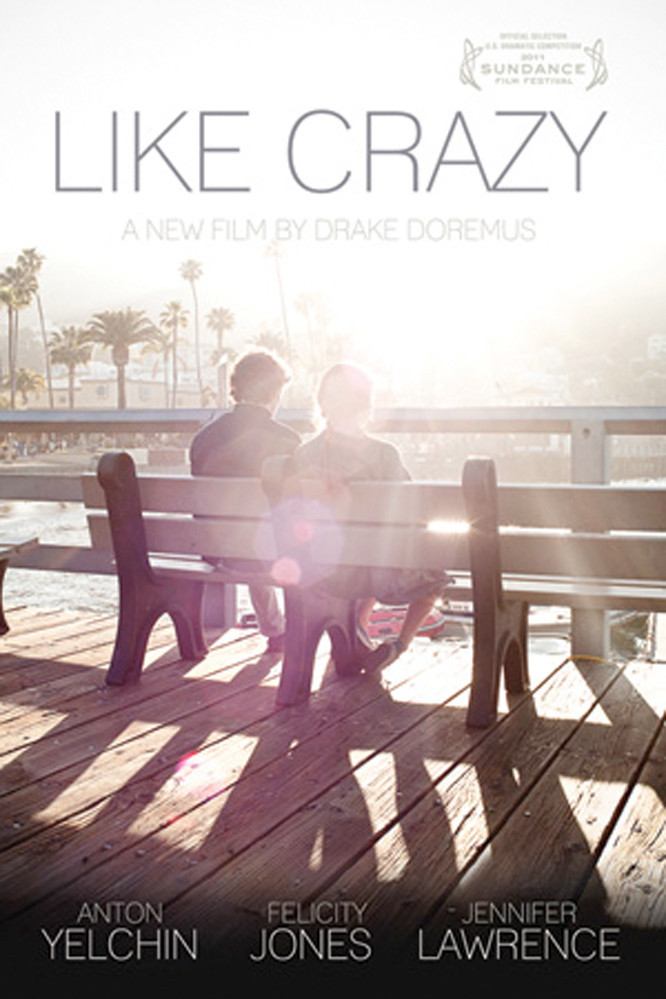
Like Crazy (2011) – Review

Review: Like Crazy is beautiful and tragic, almost at the same time. The romance story follows Jacob and Anna, two college students who fall in love – the problem is that Anna is in the States on a school visa, and she overstays it to be with Jacob. Thus, when she goes home to England to visit her parents and attend a family wedding, she is unable to return to the States and be with Jacob, setting up the struggles of maintaining a long-distance relationship. Writer-director Drake Doremus seems to be most interested in each character’s internal struggle between their commitment to each other, which is difficult as they are separated by about 5,400 miles and due to this distance each develops their own life where they are, making it all the more challenging to stay committed. Doremus takes such a naturalistic and organic approach to the story, which is very refreshing (given the current cinematic climate of boring structurally cliché romances), with his aesthetic style (using natural light and freehand camera work) and mostly improvised dialog (allowing the actors to play off each other in the moment). This approach is very appealing and ultimately leaves the film feeling a cut above most in its genre as the viewer does not know where the story or characters are headed (unlike almost every other romance or rom-com to come out recently). It does not seem to have a conventional three-act structure either (and while one can be argued, it does not work in the same way as most films). The emotional journey of Jacob and Anna does not follow the high-low-high formula; it plays much more organically with highs and lows of varying degrees happening much in the same way they would happen if this were a real relationship, and not something completely phony (aka, essentially every rom-com and most romances). And the characters themselves feel more real than what the genre typically gives us. Neither one is right or wrong, rather both are right and both are wrong. In the vein of The Graduate, the ending is ambiguous (something critics, cinema and indie fans seem to like and cheap-entertainment seeking movie-goers hate), but it works very well given the structure and characters. Basically, the whole film has been building to the last scene(s), the characters facing many obstacles and triumphs and here they are where they wanted to be and now what. Doremus handles the last moments extremely well, as Anna and Jacob face the future and present which seems a bit on the murky side, but they look to the past specifically why they love each other, but again we are left to make our own conclusions. I also think that the film and Doremus play with the idea of soul-mate versus obligation (or commitment). Do Anna and Jacob fight so hard and give up so much because they really do love each other (and are soul-mates) or do they feel a socially dictated obligation to each other, growing up in a society that still puts pressure on things like family, commitment and so on as moral goals (and norms)? Like Crazy is a good film because it does not placate or sell itself out to typical genre beats; rather it respects the idea of love and delves into the joys and struggles of what being in a relationship is really about. As viewers, we can all relate because it is so honest.


Technical, aesthetic & acting achievements: Drake Doremus has written and directed three other features, but Like Crazy is the first to receive any form of real commercial distribution (thanks to winning Sundance and having marketable cast names), thus it in a way can be treated as his first feature (at least in a commercial sense). That said, it is a great first film. His approach to the genre is really what stands out and makes the film as endearing as it is (even though I would not call it a feel-good movie). Like many directors that have put out great films, early in their potential careers, this year, I look forward to seeing what he does next. Composer Dustin O’Halloran’s score (his first in a distributed film) is perfect for the tone and style of the film. It also goes hand-in-hand with the good found music, but is not overshadowed by it (here is an excerpt). It hits the right emotional notes to accompany the performances. John Guleserian’s cinematography is beautiful. He utilizes natural light wonderfully, but what really stood out was his use of color, which also goes with the work of production designer Katie Byron who presents the film in such a real space but also has an eye for striking color. (While I honestly do not remember completely if this is the case, I think) the color in the falling in love scenes is so vibrant that when things start to become more of a struggle, there is an almost shocking lapse in color. It is very good work. The film’s narrative is really centered on two characters, with all supporting roles mostly reduced to space-holders. However, Charlie Bewley and Jennifer Lawrence are good in their small roles. Oliver Muirhead is probably the standout in the supporting cast as he sort of steals most of his scenes. Anton Yelchin is very good as Jacob, as he weighs the emotional decisions on his face. Felicity Jones is wonderful as well. She brings so much life the character and film that it is difficult to see some of her light dampened through the narrative. Both give so much with their faces that really the film could have played without dialog.

Summary & score: Like Crazy is a touching romance (both sad and happy) that rejuvenates the genre. 8/10 

Tuesday, November 15, 2011

J. Edgar (2011) – Review

Review: J. Edgar is a mix of things that work and things that do not work, but ultimately ends up being a good biography, just weighed down by odd and clumsy choices. The film is about the career of J. Edgar Hoover – his rise through the Justice Department becoming the founder of the Federal Bureau of Investigation to the power hungry seemingly out-of-touch petty old man still clinging to whatever power he has left. Director Clint Eastwood structures the film to be told through the writing of Hoover’s biography, cutting frequently between the past (mostly the 1920s and 1930s) and the present (1960s). The past reveals a man driven to create a better crime-stopping force, while dealing with issues of an over aggrandized ego and social awkwardness. The present however, just shows the man as sort of a wretch nefariously doing whatever to hang on to power and promote himself above all else, crippled by having to hide part of himself from the world. As a straight-forward biography, the film is at its best, and Eastwood’s style seems to be at its most comfortable – focusing on the look of the times, deeds and facts (though the film presents them as being a bit on the fuzzy side, as Hoover is an unreliable narrator/protagonist) is when the film is the most engaging and interesting. However, it is when Eastwood delves into Hoover’s character specifically the relationships that he has with his mother, life-long secretary Helen Gandy and friend/FBI colleague Clyde Tolson that the film seems to drag and not work. Sticking out the most are two factors: first, Eastwood’s piano score (especially in the scenes with his mother and later Clyde) feels completely wrong for the tone and takes the viewer out of the film. Second, the casting (and/or performances) is very uneven. Many scenes simply do not work primarily due to actors mismatched to roles, which is most prevalent in Hoover’s relationship with Tolson. Plus, Eastwood structuring the film to be about Hoover’s career as told by him disconnects the audience when it suddenly veers into ‘character scenes’ (again, especially those with his mother) as it halts the momentum. The film very well may have benefitted from a different structure – given the need to explain why Hoover was the way he was, while also reviewing his career highlights. The three characters closest to Hoover (his mother, secretary and best friend Clyde) are all quite strange, seemingly giving up their lives to solely support his, which makes them problematic as film characters as they really have no depth (maybe with the exception of Clyde who is actually given some dramatic beats) when they need to so that their relationships actually have meaning for the viewer. Rather than being fully fleshed out characters, they simply exist to help shape Hoover – who is very well fleshed out and with a great performance given by Leonardo DiCaprio is really the reason the film works at all or is interesting at all. DiCaprio carries every scene he is in. And while this is a film about Hoover, driving deeper into the supporting characters would have given the audience a better understanding of who these people were and why they acted the way they did towards Hoover, shaping him. As is, they just seem very odd, and tragic given the times and social perception of same-sex relationships (and maybe that is the point Eastwood wanted to make – not only was Hoover self-destructive to a certain extent, but he also ruined those closest to him as well). Despite J. Edgar’s many flaws, Eastwood does still manage to make a good biography, especially for those interested in the man, his deeds and the times.


Technical, aesthetic & acting achievements: Clint Eastwood has long established himself as one of the best auteur directors working today (even though I would argue that his last few efforts were not that strong). With J. Edgar, it is clear that he still has the ability to make a film with great aesthetics and performances (there are just structural and character issues). Eastwood has worked with the same team on his last five films to very good results (regardless of whether the film worked or not). Tom Stern’s cinematography is again excellent, and the very desaturated look matched both the tone of the film and character of Hoover. James J. Murakami’s production design is also very good, and challenging as he needed to work in multiple decades – and yet there is a style continuity that still exists throughout seamlessly. Eastwood provides his own score, as he often does (since 2003). It is not only the weakest of the artistic elements of the film, but also damages the narrative and tone overall as it does not work or fit at all, which is unfortunate. It completely disengages the audience and seems to bring the narrative momentum to a sudden and jarring (not in a good way) halt. Performance wise, J. Edgar is all over the place. Judi Dench is fine in her performance as Hoover’s mother, but her character is given no depth making all her scenes boring, as they bring the narrative to a stop, essentially (save for the ‘daffy’ scene). Naomi Watts is good as Hoover’s secretary, but is really given very little drama or acting to do. Armie Hammer seems completely miscast as Hoover’s best friend and colleague Clyde Tolson (just as Jeffrey Donovan seems awfully miscast as Robert Kennedy), or his performance is just off (and maybe both). He is given some dramatic scenes, but they seem to come too late and too few. DiCaprio, however, is very good as Hoover, which is a challenging role, playing a complex and issue-ridden man across multiple decades, who hides himself from the world his whole life in public and private – playing the character of the perfect moral man, if you will, while secretly feeling differently. Again, he completely carries the film and is the reason it works at all.

Summary & score: As a period biopic, J. Edgar is very good. But as a character drama, it does not work nearly well enough. However, the former carries the latter enough to make it a good film. 7/10

Monday, November 14, 2011

Movie of the Week – The Godfather: Part II

This week’s movie is The Godfather: Part II (1974).

The film picks up a few years after the events of The Godfather. It is split between Michael’s struggle to expand his empire and the beginnings of his father Vitto coming to New York as a small boy and growing into ‘The Godfather’. Like Part I, the film is written and directed by Francis Ford Coppola, and he bought back his same crew with composer Nino Rota, cinematographer Gordon Willis and production designer Dean Tavoularis. Most of the cast returns as well with Al Pacino, Robert Duvall, Diane Keaton, John Cazale, and Talia Shire all reprising their roles. The film also features excellent performances from newcomers to the series, chiefly: Robert De Niro (who won an Oscar for his work), Michael Gazzo, Lee Strasberg, and Bruno Kirby. The film won the 1975 Oscar for Best Picture, Coppola Best Director (among other Oscars) and is number 32 on AFI’s Top 100 American Films of all-time (it is the only sequel to make the list). However, many critics call it even better than the first, claiming it is one of the few films to top the original in a series (though it is more common outside of drama: Spider-Man 2, The Dark Knight, From Russia with Love, The Two Towers, and many would say The Empire Strikes Back). Coppola had a tough time directing the first film and wanted to only stay on as a producer and hire another director. He chose Martin Scorsese, however the financiers negated him and Coppola agreed to return to the director’s chair. At the time, the only film of note that Scorsese had made was Mean Streets. Along with The Godfather, this is one of the most iconic crime dramas (gangster films) and a must-see. Check out the trailer.


Available on Blu-ray, DVD and Streaming

Thursday, November 10, 2011

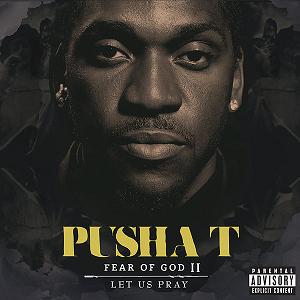
Pusha T – Fear of God II: Let Us Pray EP (2011) – Review

Pusha T – Fear of God II: Let Us Pray
Pusha T’s first commercial release as a solo artist and member of G.O.O.D. Music is a follow-up EP to his mixtape Fear of God. The EP features seven new tracks and five off Fear of God. Of the new tracks, three or four are album quality while the rest feels like mixtape material. Trouble on My Mind featuring Tyler, The Creator and produced by The Neptunes is a standout song (and one of my favorites of the second half of the year, plus the video is great too). The production quality outside of The Neptunes is not quite as good on the new tracks as those previously released, but they have more of a street-banger feel, which probably speaks to Pusha T being in a different place musically for Let Us Pray than when he recorded Fear of God. However, lyrically and delivery wise, Pusha T still comes with great flow and composition. We all knew he was great from his previous work with his brother Malice as a member of Clipse (the album Hell Hath No Fury is brilliant), but that said he is certainly putting forth very good material as a solo act that puts him near the top of the hip hop game. To me, this sounds more like another mixtape and is being used to test the commercial waters a bit. Though, Trouble on My Mind is good enough to make just about any hip hop album released this year. The Fear of God albums feel like just a preview of what we can expect from his first solo LP, which seems like it will be fantastic given his lyrics, flow and the better class of beats he will have on it. In terms of features, again just looking at the new material, Tyler, The Creator give a great verse and a half and is the standout accompanying act on the EP. Kanye West and Young Jeezy are decent but not memorable. Meek Mill lays down a good verse too on Body Work. However, aside from Tyler, The Creator, it is Ric Flair’s wrestling promo clip at the beginning of What Dreams Are Made Of that might be the best accompanying piece, it is both a brilliant clip and works well with the narrative of the album and the persona of Pusha T. I would not say the album is a must, based on the new material, especially if you have Fear of God and Trouble on My Mind already, but it is certainly a good pick up for fans of Pusha T, and a must if you do not yet have Fear of God. 4/5

Editor’s Song Picks:
1)      Trouble on My Mind – Produced by The Neptunes, featuring Tyler, The Creator
2)      Changing of the Guards – Produced by Rico Beats, featuring Diddy
3)      Amen – Produced by Shawty Redd, featuring Kanye West and Young Jeezy

Available on CD and Digital Download

Wednesday, November 9, 2011

Leonardo DiCaprio – Movies Spotlight – November 2011

Leonardo DiCaprio, 37, is still probably best known for his role opposite Kate Winslet in James Cameron’s Titanic. However, in recent years he has become one of the best leading men in Hollywood. This month he stars in the Clint Eastwood directed biopic J. Edgar about J. Edgar Hoover, the first director of the FBI.

Early Career:

DiCaprio began his career making appearances in commercials and educational films before getting his first break picking up a role in the soup Santa Barbara and a series regular role in Parenthood (the short-lived series based on the Ron Howard movie) in 1990. He continued to get TV work with roles on Roseanne and Growing Pains, and he got his first film role in 1991 on the sci-fi comedy Critters 3 and then another in Poison Ivy. His work on Parenthood garnered him a nomination for Best Young Actor from the Young Artist Awards. However, it was not until Robert De Niro chose him out of four hundred young actors to co-star with him that he had his real breakthrough. The film was 1993’s This Boy’s Life.

Breakthrough as a Child-Actor:

After This Boy’s Life, DiCaprio followed it up with another fantastic performance in What’s Eating Gilbert Grape, co-starring and even upstaging Johnny Depp as Depp’s mentally handicapped brother. Director Lasse Hallstrom was reluctant to cast him at first, as he felt DiCaprio was too good-looking for the role, but found that he was the best among the auditions by far. He earned his first Oscar nomination for the performance. Next, he worked with Sam Raimi on the campy western The Quick and the Dead playing the cocky son of the town’s big man. DiCaprio’s performance is fun, the film does feature a few great actors (like Gene Hackman and Russell Crowe) and is entertaining in spots, but it does not hold up too well as a whole. He also made his next critical hit in 1995 with The Basketball Diaries, a biopic about Jim Carroll.


Titanic – Becoming the Biggest Star in the World:

DiCaprio had established himself as a good young actor, one that critics knew and praised, but he was not yet a star or box office draw. That changed in 1996 when he was cast opposite Claire Danes (who was the bigger of the two, star wise, at the time thanks to My So-Called Life) in Baz Luhrmann’s Romeo + Juliet. Luhrmann updated the style and look of Shakespeare’s play to feel more modern and hip and cast Danes and DiCaprio in an effort to appeal to younger film goers, and it worked. Even today, the film is one of the most iconic romances of its generation. Next, he took a role in Marvin’s Room playing opposite Robert De Niro again, as well as Meryl Streep and Diane Keaton, truly testing his skills as an actor.  The film is okay, but DiCaprio came out of it being called an equal to the wonderful actors sharing the screen. Now having both critical praise and commercial appeal, he was ready to become a huge star. The film that did it for him was his next – Titanic. Before Avatar topped it, Titanic was the highest grossing film of all-time, and it won eleven Oscars including Best Picture. It made DiCaprio one of the biggest stars in Hollywood and also one of the main heartthrobs from teenage girls. However, the film also had some backlash for him, as it was too big and a little too sappy. Critics and some audience members seemed to dislike him purely due to his association with the film and line ‘I’m the king of the world’, which was on repeat in pop-culture after the film (and to some extent still is). He may never be quite as popular as he was around the time of that movie. Now, as a big star, studios started to place him in bigger films. First up was United Artists’ The Man in the Iron Mask, directed and written by Randal Wallace, coming off his big hit Braveheart (which he wrote). The movie was a failure critically but made money commercially. He then made Celebrity with Woody Allen, which is one of Allen’s lesser films, appearing in a self-mocking cameo. And then Fox put him in The Beach, the second of their two film experiment with director Danny Boyle that yielded two disappointments for them critically (though I am a fan of both The Beach and A Life Less Ordinary). However, the film was a success at the box office thanks to DiCaprio’s fame (and the same goes for The Man in the Iron Mask). Both films garnered him Razzie nominations (not because he is bad in them, but due to the Titanic backlash).


Collaborations with Martin Scorsese:

DiCaprio has had one of his most fruitful actor-director relationships with Martin Scorsese. They have made four films together, beginning with Gangs of New York in 2002. Scorsese initially had trouble getting a studio interested in the film, but when DiCaprio became interested in starring, coming off three box office hits in a row, Miramax jumped in to finance the project. However, the filming was plagued with creative disputes between Scorsese and the producers as well as multiple budget overflows. It is the most expense film Scorsese has made. Despite the issues, the film received critical acclaim (for the most part, though I would argue it is one of his lesser films) and ten Oscar nods including Best Picture. While DiCaprio is good in it, giving his first grown-up performance (so to speak), he is overshadowed by Daniel Day-Lewis’s magnificent performance. Their next picture together came in 2004 with The Aviator, a biopic about Howard Hughes. DiCaprio originally developed the project with Michael Mann, but he decided to leave the director’s chair and only produce as he had just made two biopics (Ali and The Insider) and did not want to take on a third just then. DiCaprio decided to pitch the script to Scorsese after having a good working relationship with him on Gangs of New York. He spent over a year preparing for the role, which was his most difficult to date (and probably still is). The film was a financial and critical success and DiCaprio received his second Oscar nomination. In 2006 the two worked together again on The Departed, a remake of the Hong Kong film Infernal Affairs. The film was highly anticipated and became the biggest hit critically and commercially among their films together. It won Best Picture and Scorsese a Best Director Oscar at the 2007 Academy Awards. They again reunited in 2009 to make Sutter Island (which was delayed until 2010). The film is much different than most of the work either had done previously, being a psychological thriller, but it yielded both DiCaprio and Scorsese their biggest box office opening weekend of their careers to date. The pair is currently working on a few upcoming rumored projects together.


Working with the Best Directors in Hollywood:

In addition to Martin Scorsese, DiCaprio has worked with many of the best directors in Hollywood since 2002 starting with Steven Spielberg on Catch Me If You Can. DiCaprio’s performance as Frank Abagnale Jr., a very skilled forger and con-man, seemed to make him cool again with many viewers put off by Titanic. And likewise, the film was a great international success (and one of Spielberg’s better films of the decade, second to Munich). He made Blood Diamond with Edward Zwick about the Sierra Leone Civil War in 2006. He played a South African and donned an Afrikaner’s accent. He received his third Oscar nomination for the film. In 2008 he made two films, first he worked with Ridley Scott on Body of Lies, a CIA spy Middle East thriller. DiCaprio liked the film because he viewed it as a throwback to the political films of the 1970s (things like The Parallax View and Three Days of the Condor). Then he reunited with Kate Winslet in Sam Mendes’s (her husband at the time) Revolutionary Road about a failing marriage in the 1950s. Both DiCaprio and Winslet had been reluctant to work on romances in the wake of Titanic, but had remained good friends. Thus, when Winslet came with the project to DiCaprio he agreed and production started quickly. Both are fantastic in the film (and it is one of the most underrated films of the year and possibly decade). In 2010 he starred in Christopher Nolan’s action thriller Inception, yet another critical and commercial success. These films have not only made DiCaprio one of the top leading men from a talent perspective, but also one of the biggest stars in Hollywood currently.

Future Projects:

DiCaprio has two films upcoming in 2012, both scheduled for a release on Christmas Day. First he is reuniting with his Romeo + Juliet director Baz Luhrmann for an adaptation of The Great Gatsby. It co-stars Carey Mulligan as Daisy and Tobey Maguire (who he worked with on This Boy’s Life) as Nick. Then, he takes on his first role as a villain in Quentin Tarantino’s southern western Django Unchained. It is about a slave turned bounty hunter who sets out to rescue his wife from a vicious plantation owner (played by DiCaprio). It stars Jamie Foxx and co-stars Samuel L. Jackson, Christoph Waltz, and Kerry Washington (among others). DiCaprio is also rumored to be attached to Todd Fields’s new film Creed of Violence about two men in 1910 who try to stop an organized arms smuggling ring.


Leonardo DiCaprio’s Career Highlights:

1)      What’s Eating Gilbert Grape (1993) – supporting (DVD, Streaming)
2)      The Basketball Diaries (1995) – leading (Blu-ray, DVD)
3)      Romeo + Juliet (1996) – leading (Blu-ray, DVD, Streaming)
4)      Titanic (1997) – leading (DVD)
5)      Gangs of New York (2002) – leading (Blu-ray, DVD, Streaming)
6)      Catch Me If You Can (2002)* – leading (DVD)
7)      The Aviator (2004) – leading (Blu-ray, DVD, Streaming)
8)      The Departed (2006)* – leading (Blu-ray, DVD, Streaming)
9)      Blood Diamond (2006) – leading (Blu-ray, DVD, Streaming)
10)   Body of Lies (2008)* – leading (Blu-ray, DVD, Streaming)
11)   Revolutionary Road (2008)* – leading (Blu-ray, DVD, Streaming)
12)   Shutter Island (2010) – leading (Blu-ray, DVD, Streaming)
13)   Inception (2010)* – leading (Blu-ray, DVD)
*Editor’s picks

Tuesday, November 8, 2011

Martha Marcy May Marlene (2011) – Review

Review: Martha Marcy May Marlene is a building drama that sometimes feels like a thriller – and yet there is very little action and slowly paced. The thriller aspect plays off an anticipation and anxiety that are felt both by the audience and the characters, specifically Martha, capitalizing on the tremendous performances. Writer-director Sean Durkin also infuses the film with ambiguity – the audience is never sure if Martha does truly have something to fear or if she is just completely emotionally compromised by her experiences within the cult-like community she flees at the beginning. Maybe the best aspect of the film is the narrative structure that Durkin employs, seamlessly transitioning between the present and the past. It works so well because the script has been expertly written to have scenes in the present play off the past and vice versa, while having each build towards a feeling of dread for Martha – it is really quite an extraordinary well-done narrative. Durkin also tackles family as an institution in the film. Martha is seemingly much more at ease and finds a real place with her ‘cult’ community (until things start to get a little dark), whereas she is certainly treated as an outsider and a lesser member in her own sister’s house. It is almost an attack on the current (and more traditional) idea of family, in that within our own family (parents and siblings) we should be the most comfortable and close with these people but in reality it is often outsiders that we connect to more so – as we choice these people while family is essentially forced luck – family as a unit of blood relation may be (or already is) more of an archaic notion in our seemingly modern society, where we are more spread out and more reliant of superficial communication (and maybe more selfish). None of the blood relationships that Martha has seem to meet the level of comfort that she has when first integrated into the ‘cult’ community, which then plays more into the paranoia and total emotional and to an extent psychological collapse that she faces when that community turns out to be problematic for her. Durkin also allows the performances to be emotive and does not try to force his characters into anything inorganically. Something else that struck me about the film was its shooting style – in that Durkin seemed to almost have a voyeuristic approach to the way he shot Martha (it reminded me a little of the work of Larry Clark), putting the audience in the mindset of Patrick or even Ted to some degree. It feels a little disarming, because clearly Martha is sexualized but at the same time she is fragile if not broken, making the style a little on the uncomfortable side (than sexy). Martha Marcy May Marlene overall is a very well-constructed drama that plays off our own emotions and insecurities as viewers as we empathize with Martha (thanks to the fantastic performance). Much like with Lars von Trier’s Melancholia (and Jeff Nichols’s Take Shelter), Durkin has made a film about sadness and emotional hardship and turned it into a thriller of sorts.


Technical, aesthetic & acting achievements: Sean Durkin makes his feature debut with this film, and it is certainly an impactful first feature. I look forward to his next. Composers Daniel Bensi and Saunder Jurriaans add to the anxiety that Durkin creates with their score, which is basically menacing tones. Plus, there is the fantastic song John Hawkes performs in the film (Marcy’s Song) that captures the essence of the film. Jody Lee Lipes’s cinematography is very good. (Maybe it was just me but) it seemed to get darker as the film progressed, as if using a bleach bypass process. Lipes and Durkin also use varying planes of focus, and sort of a soft focus at times creating an almost angelic look for Martha. Nature plays a big role as well, both as something beautiful and terrifying. It is great work for a relative newcomer. Production designer Chad Keith provides a good naturalistic look to the film that is very fitting as well. The film is built upon the performances of its actors, and they are all very good. Hugh Dancy and Brady Corbet (in a small role) stand out among the smaller supporting roles, while Sarah Paulson is great in her larger supporting role. John Hawkes is brilliant, projecting feelings of menace and love seemingly in the same breath. However, it is Elizabeth Olsen who stands out the most. She gives so much of herself just through her eyes. She has to play a character with such emotional range throughout the film, and she does so capturing the beauty and tragedy perfectly. She completely engages the audience. She is a star in the making.


Summary & score: Martha Marcy May Marlene is a very good drama, that works as a thriller too, featuring a wonderful narrative style, beautiful cinematography and one of the best performances of the year from newcomer Elizabeth Olson. 8/10

Monday, November 7, 2011

Movie of the Week – The Godfather

This week’s movie is The Godfather (1972).

The first part of the crime drama trilogy is about the aging patriarch of a crime family and the ascension of his reluctant son. It is directed and written by Francis Ford Coppola, who was probably the greatest working director of the 70s with films like The Godfather and The Godfather: Part II, The Conversation and Apocalypse Now. He worked with composer Nino Rota, cinematographer Gordon Willis and production designer Dean Tavoularis – all of which do fantastic work. The cast is also fantastic, especially the leads Marlon Brando and Al Pacino. James Caan, Robert Duvall, Sterling Hayden, Diane Keaton, Talia Shire, Al Lettieri, and John Cazale are great in support. The Godfather is ranked number three on AFI’s list of the top 100 American films of all-time and is one of the most iconic gangster films. With the end of the production code in the 60s, filmmakers had a lot more artistic freedom and the ability to show much more graphic material, both of these aspects influence the style that Coppola creates with the film. It is one of the shining moments for filmmakers working in this era “New Hollywood”. Coppola emerged as part of the new group of American auteurs who would change cinema (along with Martin Scorsese, Steven Spielberg, George Lucas, and Brian De Palma; Roman Polanski is also usually included in this group too, though he is not American). This is a must-see for all cinema fans, and especially those who like gangster films. Check out the trailer.


Available on Blu-ray, DVD and Streaming

Thursday, November 3, 2011

Wale – Ambition (2011) – Review

Wale – Ambition
After his critically acclaimed but commercial failure debut Attention Deficit (one of my favorite hip hop albums of 2009), Wale needed a change. It came in the form of teaming up with Rick Ross on his label Maybach Music Group, garnering singles such as 600 Benz (off their label album Self Made Vol. 1). Many fans thought that he was going to sellout and change his style to be more commercial. But the only thing that has changed from Attention Deficit is the beats Wale is rapping over. The lyrical style and content are the same. He has such energy and an infectious lyricism that it is hard to dispute Wale as one of the best right now. No one else sounds quite like him. And for a large portion, his sound has not really changed much either – songs like: Lotus Flower Bomb, Sabotage and Miami Nights could easily be off any of his former releases. If anything, I like that he is incorporating new beats into his style and trying to grow as an artist. I mean is it not the goal to reach as many listeners as possible while maintaining your lyrical integrity, because that is what Wale has done with Ambition. I think he has a great chemistry with producers Tone P and Mark Henry, who both have multiple tracks on the album. But, he also has completely different beats too like Diplo’s Slight Work and beats that fit the popular trend right now, specifically from T-Minus. While it is as good an album as Attention Deficit, it is one of the better hip hop albums of 2011 and I look forward to more form Wale. 4/5

Editor’s Song Picks:
1)      Focused – Produced by Kore, featuring KiD CuDi
2)      Double M Genius – Produced by Mark Henry
3)      Ambition – Produced by T-Minus, featuring Meek Mill and Rick Ross

Available on CD and Digital Download

Wednesday, November 2, 2011

TV Series of the Month – The Young Ones

This month’s TV series is The Young Ones (1982, 1984).

The British comedy is about four college students who live together – a punk, a hippie, an anarchist, and a gigolo. It was created by Ben Elton, Rik Mayall and Lise Mayer, with additional writing from Alexei Sayle. The cast is a brilliant mix of comedians, coming from performing at the Comedy Store (now The Comedy Strip) in London. It stars Adrian Edmondson, Rik Mayall (who were college friends and perform together as 20th Century Coyote), Nigel Planer, Christopher Ryan, and Alexei Sayle. The series also features cameos from Robbie Coltrane, Dawn French, Jennifer Saunders, Stephen Fry, Hugh Laurie, and Emma Thompson. While being one of the funniest shows of all-time, The Young Ones has had a huge influence on the British sitcom. Even though it is about four male students living together, it still manages to create the family dynamic with the father, mother and two children. The show also features musical guests including Motorhead, Madness, The Damned, and more. It is a must-see for fans of comedy series, especially British comedy. It is probably my favorite comedy series. Check out the trailer.


Available on DVD and Streaming

Tuesday, November 1, 2011

Take Shelter (2011) – Review

Review: Take Shelter is a building character piece that has a magnificent pay-off. Writer-director Jeff Nichols paces the film in such a way that the tension builds and weights not only on the characters but also the viewers. He invites us into the world and mind of Curtis, completely investing our attention in his journey and outcome, and this connection is vital as the slow pacing will ultimately alienate those that do not connect. That said this film is not going to work for all viewers. There is not much action – most of the tension and drama plays out in the eyes of the characters. However, despite the slow pacing the end of the second act and the whole third act is incredibly well done, completely paying off all the character drama done up until those moments. Nicholas does not rely on special effects or explosions, and yet this is one of the most effective and affecting thrillers of the year. The sense of an impending dread that he creates is fantastic – even as we doubt the mental faculties of Curtis, the fear still sets in within us that something is coming. Take Shelter is built around the brilliant performance of its lead and while slow at first, it has extremely gripping third act, in which we are not even sure what to believe.


Technical, aesthetic & acting achievements: Jeff Nichols has now made two films (the other being Shotgun Stories), and has quietly established himself as one of the better indie directors working right now. I am definitely eager to see what he does next. Composer David Wingo’s score is probably the best of his career (or at least very close), as it works very well getting the tone just right – something that is particularly vital to a film such as this. Adam Stone’s cinematography is also very good (this is his first film to receive a wide distribution and I imagine he will be in high demand now). Production designer Chad Keith’s sets are very simple and fit both the tone and style of the film perfectly, allowing for the performances to be the main focus. Katy Mixon, Kathy Baker, Ray McKinnon and Shea Whigham provide good supporting work. Newcomer Tova Stewart is good as well in what was probably a difficult first performance. Jessica Chastain (having a fantastic breakthrough year) also has a very difficult performance playing against the lead, yet she does so beautifully. Michael Shannon is phenomenal in the film –both in the subtly, emoting emotion purely with his eyes, and physically, as the strain seems to become too much as the film develops, aspects of his performance. It is among the best of the year.

Summary & score: Take Shelter is a powerful thriller that seems to pierce into our own fears and dreads through brilliant performances and tone. 8/10

Monday, October 31, 2011

Movie of the Week – Monster House

This week’s movie is Monster House (2006).

The Halloween movie is about three teens that discover their neighbor’s house is alive. Thus, they set out to release the spirit haunting the house to protect their neighborhood. The film marks the directorial debut of Gil Kenan (who has since also directed City of Ember). He decided to do the film with all the character performances being 3D motion-captured, which (while the animation already is a bit dated compared to recent stuff) gives the character performances on the screen a lot of life, especially in their facial expressions. The whole film was shot with the actors and then the animation was laid over their performances. It was also the second film to feature the Real-D digital 3D format. It was executively produced by Steven Spielberg and Robert Zemeckis, which is probably why it has such a great nostalgic feeling to it. It reminds me of the great movies I loved (and still love) as a kid (things like The Goonies). Douglas Pipes also provides a festive score and the visual aesthetic of the film is fantastic as well, thanks to Kenan, production designer Ed Verreaux and cinematographers Paul Babin and Xavier Perez Grobet. The cast is great as well. It stars newcomers Mitchel Musso, Sam Lerner and Spencer Locke. Steve Buscemi is also wonderful in support. Catherine O’Hara, Fred Willard, Maggie Gyllenhaal, Jason Lee, Kevin James, Nick Cannon, Jon Heder, Ryan Newman, and Kathleen Turner are featured as well, many with fun bit parts. Monster House is a great Halloween family movie – it is both scary enough and funny enough to thrill, while having good characters to engage. Though it was made in 2006, it feels like one of the movies of my childhood from the 80s. Check out the trailer.


Available on Blu-ray, DVD and Streaming

Thursday, October 27, 2011

At the Movies – November 2011 – Part 3: This Month’s Best Films

Must-See of the Month:

The Muppets (James Bobin) – Comedy – Nov 23
Summary: Like the classic Muppet movies, this is about the Muppets coming together to save their theatre (from a greedy oil tycoon, specifically for this film). Filmmakers: Director James Bobin of The Flight of the Cochords and The Ali G Show makes his feature debut. Jason Segel (who is also starring and producing) and Nicholas Stroller wrote the script (they made Forgetting Sarah Marshall together), Bret McKenzie is writing a few new songs, Christophe Beck (Crazy, Stupid, Love.) is scoring, Don Burgess (Source Code) is shooting, and Steve Saklad (Up in the Air) is doing the production design. Cast: In addition to the Muppets and Segel, Amy Adams stars and Rashida Jones and Chris Cooper feature in supporting roles. The film also boasts an impressive list of celebrity cameos (here is a full list), highlighted by: Neil Patrick Harris, Emily Blunt, Ricky Gervais, Donald Glover, and Billy Crystal. Expectations: While I am a fan of the Muppets, it is Jason Segel, James Bobin and Bret McKenzie’s involvement in the production of the film that has me excited to see it (just think of Segel’s Dracula Musical in Forgetting Sarah Marshall). The cast and celebrity cameos are also awesome. The myriad of joke and real trailers have been great as well. More so than many of the Holiday family-targeted films coming out in November and December, this has the most potential to be amazing for both children and adults. This is definitely the must-see of the month. Trailer: Here. Review.

Worth Checking Out:

J. Edgar (Clint Eastwood) – Biography – Nov 9
Summary: The film is about J. Edgar Hoover, the first director of the FBI – his life, career and secrets. Filmmakers: This project seems like a very good fit for director, producer and composer Clint Eastwood (he has made some good period stuff in the past, like his recent film Changeling). The film is written by Oscar winner (for Milk) Dustin Lance Black, and Eastwood is working with his frequent collaborators cinematographer Tom Stern and production designer James Murakami. Cast: The strong cast starts with the lead Leonardo DiCaprio, but it also has a good supporting group with Armie Hammer, Naomi Watts, Dermot Mulroney, Josh Lucas, Ed Westwick, Lea Thompson, Judi Dench, Jeffrey Donovan, and Stephen Root. Expectations: Clint Eastwood and Leonard DiCaprio being a part of J. Edar automatically makes it an Oscar contender. Eastwood is a fantastic director, but he is not immune to films that do not entirely work (his last two, Invictus and Hereafter, were not great). But, DiCaprio has a very strong record with his recent projects (his last three were Revolutionary Road, Shutter Island and Inception – all receiving a review of 8 or better from me). More than likely, this will be good. Trailer: Here. Review.

The Descendants (Alexander Payne) – Dramedy – Nov 18 [limited]
Summary: The film is about Matt King. After the death of his wife in a boating accident, he tries to reconnect with his two daughters. Filmmakers: Writer-director Alexander Payne is one of the best at making dramedies because his characters are well drawn and typically sad (specifically his protagonists), and yet his dialog and situations he places them in are often very funny (his masterwork is probably Sideways). He is working with frequent collaborators cinematographer Phedon Papamichael (who did maybe the best work of his career to date on The Ides of March) and production designer Jane Ann Stewart. Cast: George Clooney stars with Judy Greer, Matthew Lillard, Shailene Woodley, Beau Bridges, Robert Forster, and Rob Huebel in support. Expectations: This is another Oscar contender (probably picture, screenplay and actor), due to its acclaim from critics based on its festival screenings. I generally really like Payne’s work, and this looks to be no different – complex characters, moving drama and very funny. Trailer: Here. Review.

A Dangerous Method (David Cronenberg) – Drama – Nov 23
Summary: The film is about the relationship between Sigmund Freud, Carl Jung and a patient Sabina Spielrein, and the birth of psychoanalysis. Filmmakers: Director David Cronenberg is known for his graphic style (both in the way he shoots violence and the mental conditions of his characters, who are often pushed to their limits). He is a beloved indie director with films like Eastern Promises, A History of Violence and The Fly. He is working with frequent collaborators composer Howard Shore, cinematographer Peter Suschitzky and production designer James McAteer (who has worked many times with Cronenberg as an art director, however this is his first major feature as production designer). Cast: The film stars Viggo Mortensen, Michael Fassbender and Keira Knightley. Vincent Cassel and Sarah Gadon have supporting roles, making for an overall excellent group. Expectations: A Dangerous Method has played very well for critics during its festival run with some believing it is an Oscar contender in a few of the major categories come 2012 (picture, directing and acting). I am looking forward to it simply because it is a modern auteur director and a fantastic cast (it is one of my top five most anticipated films yet to come out in 2011 – the others being Tinker Tailor Solider Spy, The Girl with the Dragon Tattoo, Mission: Impossible – Ghost Protocol, and The Muppets). Trailer: Here. Review.